
Decoding Polycab
Polycab Q4 FY26 Concall Summary

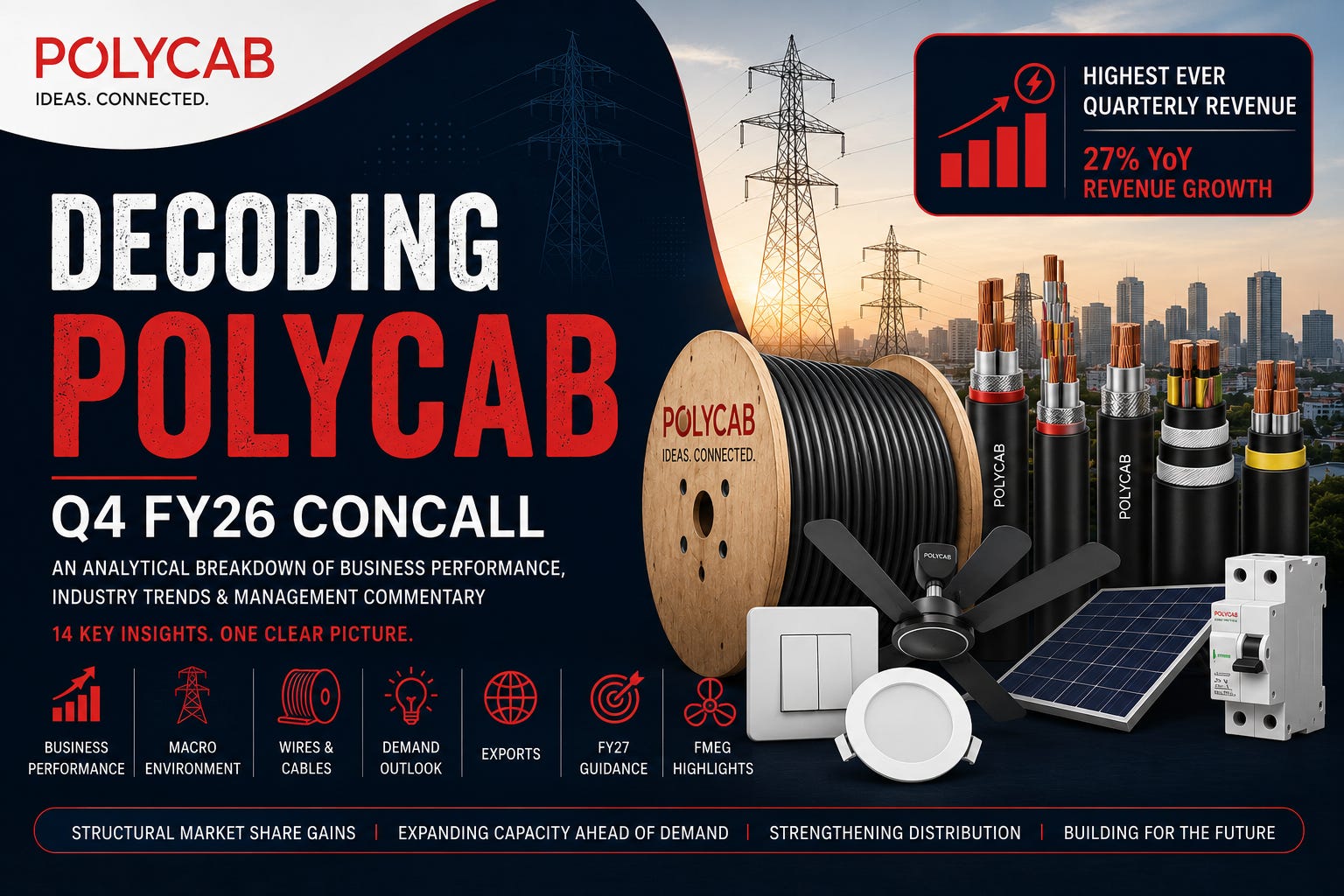
1. Business Performance
Reported the highest quarterly revenue in the company’s history.
Wires & Cables business witnessed healthy demand and strong execution.
FMEG continued to improve through a better product mix and market share expansion.
Consolidated revenue grew 27% YoY.
Organised Wires & Cables market share increased to 30–31%, which management considers a structural gain rather than a cyclical one.
FY26 capex stood at approximately Rs 1,450 crore, in line with Project Spring.
Net cash increased to around Rs 4,190 crore.
Dividend payout ratio reached 27%, moving towards the long-term target of 30%.
2. Macro Environment
Management highlighted a rapidly changing macro environment.
Key observations included:
Rising crude oil prices.
Inflationary pressures.
Higher bond yields.
Central banks becoming more cautious on rate cuts.
The era of synchronized global monetary easing appears to be ending.
Despite global uncertainty:
India’s GDP growth remains around 7.6%.
Consumption trends remain encouraging.
Credit growth continues in double digits.
Government capex remains on track.
Private capex is improving.
Real estate activity remains healthy.
Inflation remains manageable.
Lower borrowing costs continue to support consumption.
3. Wires & Cables
Volume Growth
W&C revenue grew 30% YoY.
But volume growth was only low single digits.
The difference came from nearly 18–19% cumulative price increases between January and March as copper and PVC prices surged but overall W&C volume growth remained 18% in FY 26 which is industry leading growth.
Management attributed this to:
Temporary construction restrictions in parts of North and West India.
Softer demand sentiment due to geopolitical tensions in the Middle East.
However,
Cable volumes performed better than wires.
International business is expected to recover because of a healthy order book.
Pricing
Between January and March,
price increases of approximately 18–19% were implemented.
Management stated that:
Raw material price increases were passed on almost immediately.
No inventory gains or losses were booked because of the company’s hedging mechanism.
Capacity
Current utilisation remains around 75–76%.
Management prefers expanding capacity before utilisation reaches peak levels.
Typical operating range:
Comfortable utilisation: 80–85%
Peak utilisation: around 90%
No capacity constraints exist today.
Raw Materials
Polycab remains well positioned because of:
Strong backward integration.
In-house compounding capabilities.
Diversified supplier base.
Healthy raw material inventory.
Copper is imported.
Aluminium is sourced domestically.
PVC and XLPE price increases were successfully passed on to customers.
4. Demand Outlook
Management remains optimistic about the next 24–36 months.
Growth drivers include:
Government capex.
Private capex.
in areas like
Utilities.
Manufacturing.
Metals.
Semiconductor investments.
Oil & Gas.
Logistics.
Emerging areas:
Defence.
EV infrastructure.
Data centres.
Power remains the primary growth driver.
Power capacity additions in FY26 were almost 2x FY25, reaching around 55–56 GW.
Government capex of around Rs 12.2 lakh crore, together with rising private investment, is expected to support future demand.
5. Exports
Management considers exports one of the biggest long-term growth levers.
Highlights:
US distribution network has been re-established and tariff situation is also settled.
North America is expected to become a major export market.
Europe also offers significant opportunities because of ageing power grids requiring modernization.The
Middle East currently contributes around 15–16% of exports.
Near-term contribution from the Middle East may remain subdued because of geopolitical issues, but reestablishment will be done in the Middle east which is impacted by the war, will drive future demand
6. Management Guidance
Under Project Spring, management has guided for:
• Wires & Cables revenue growth of 1.5x the industry growth rate
• FMEG revenue growth of 1.5–2x the industry growth rate
• Export contribution of 10% by FY30
• W&C EBITDA margins of 11–13%
• FMEG EBITDA margins of 8–10%
• Annual capex of Rs 1,200–1,600 crore through FY30.
7. Distribution vs Institutional Business
Management highlighted an important difference:
Institutional sales increased by 2–3% during the quarter.
Distribution business generates 3–4% higher margins than institutional business.
This reinforces why Polycab continues to prioritize expanding its distribution-led business.
8. FMEG
Fans
Growth was affected by:
Delayed summer.
Temporary inventory adjustments.
Changes in BEE energy-efficiency norms.
Despite this,
Premiumization continues.
Premium fans now contribute around 25% of fan sales.
Lighting & Luminaires
Despite industry-wide price deflation:
Both value and volume grew.
Premium products account for around 35% of lighting sales.
Energy-efficient lighting continues to gain traction.
Solar
Solar recorded approximately 2x YoY growth.
Growth is being driven by:
Government incentives.
Rising consumer adoption of rooftop solar.
Solar is emerging as one of the strongest categories within FMEG.
Switches & Switchgear
Growth continues to be supported by:
Strong residential real estate demand.
9. EHV Expansion
Extra High Voltage (EHV) capacity is expected to be commissioned by the end of the current calendar year.
Revenue contribution is expected to begin from FY28.
This is primarily a tender-based business and represents an important future growth opportunity.
A few management comments that deserve more emphasis
1. Demand is being deferred, not destroyed
This was one of management’s strongest messages.
They repeatedly indicated that the current slowdown is temporary.
Examples they gave:
Construction restrictions
Middle East uncertainty
Short-term softer demand sentiment
But underlying demand from:
Power
Real estate
Private capex
Manufacturing
remains healthy.
This is an important management commentary because it changes the interpretation of low volume growth.
2. International business recovery
Strong recovery expected in international business due to healthy order book.
3. Budget Opportunity
They highlighted
₹12.2 lakh crore Government Capex announced and if you add private capex to that the total ₹36–37 lakh crore to be invested in FY 27.And around 57% of this investment falls into sectors that consume large amounts of wires and cables.
4. Cash Position
Keep pumping cash into capex
Aims to increase the dividend payout Ratio
Also, management is keeping evaluating certain M&A opportunities, but nothing in near to mid term
5. Export Geography
Management gave a full export mix.
Approximately
US market or North America
≈40%
South America
≈20%
Middle East
≈15–16%
6. End-Use Demand Mix for Cables
Management explained that, on a normalized 12-month basis, the power sector accounts for around 40–45% of total cable demand, making it the largest end-user segment. Manufacturing and private industries contribute another 35–40%, reflecting strong industrial and private capex demand. Mobility infrastructure, including railways, roads, highways, seaports, and airports, accounts for 10–12% of demand, while energy exploration sectors such as oil & gas, coal, and mining contribute 5–6%. The remaining demand comes from emerging applications like defence, EV charging infrastructure, and other niche sectors, which are expected to become increasingly important growth drivers over time.
7. Capacity Philosophy
Not just utilization.
Management explained how they think.
They don’t wait until plants reach 90%.
Once utilization reaches 70–75%, they begin expanding capacity. This tells investors that management prefers capacity ahead of demand instead of capacity after demand.
8. Market Share
30–31%.
But management also stressed
Structural gains
NOT
Cyclical gains.
9. Commodity Pass-through
One subtle but important point.
Management said Every raw material increase in
Copper
Aluminium
PVC
XLPE
was passed through.
And because of hedging, there were
No inventory gains.
Many investors wrongly assume rising copper automatically boosts profits.
Management clarified it doesn’t.
10. Backward Integration
Management specifically explained they don’t buy finished XLPE compounds. They buy Resins and perform compounding in-house.
That’s a much deeper competitive advantage.
11. EHV Opportunity
Management also noted something very interesting.
EHV is Tender-based, not retail.
Meaning the economics, customer behavior, and competitive landscape are completely different from house wires.
The biggest takeaway while reading this concall:
“Management is investing ahead of demand, not reacting to demand.”
That single sentence summarizes
Capex
Distribution
Export expansion
EHV
Project Spring
better than pages of notes.